
Insights
J.S. Held Acquires Element Forensic Engineering, Expanding Insurance-Focused Capabilities for Mid-Market and Large Loss Property Claims Across Canada
Read MoreThe article was originally published in the September 2025 edition of Middle East Insurance Review.
As we enter the peak summer period (the UAE experienced temperatures upward of 50 degrees Celsius in May 2025), insurers’ daily business interruption (BI) exposure increases significantly at many independent power producers (IPPs) due to the contractual provisions within many purchase agreements (PPA/ WPA/PWPA) which govern the supply of power and/or water to the offtaker.
Where IPPs are predominantly paid for capacity, PPAs often include deductions for unavailability, which can be particularly punitive during the summer months when demand is at its highest, as residents and businesses ramp up air conditioning consumption to beat the heat.
In this article, we will discuss power generation losses at IPPs across the UAE and wider region, which are typically insured on a capacity loss basis (as opposed to generation / output basis) and the impact that seasonality can have on the measurement. The following information may be of particular interest to IPPs, insurers, reinsurers, brokers and loss adjusters who are involved in buying, placing, underwriting or claims handling for power companies.
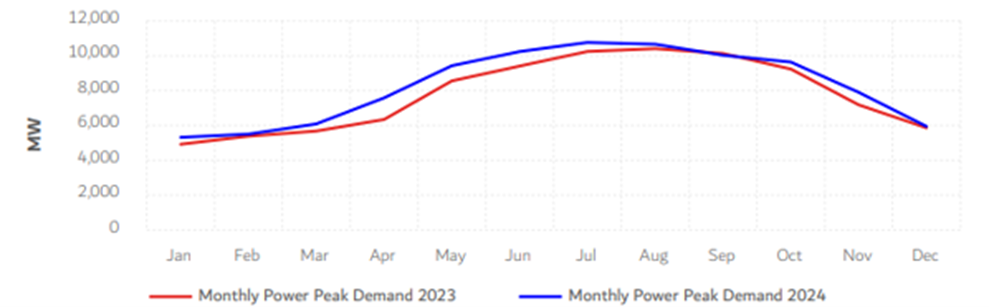
Figure 1: Dubai Electricity and Water (DEWA) Peak Power Demand (MW) [1]
During the summer period [2] scheduled outages are generally prohibited by the offtaker, and forced outages are penalised by a factor [3] of between 1 and 1.5 depending on the excess levels of outage (for example, an outage caused by an insurance incident) over and above a limited allowance in the PPA/PWPA (typically only 2-3% is allowed per month during summer before the deductions kick in).
The deduction factors are applied if the actual loss of capacity is greater than the projected loss of capacity, as follows:
Conversely, if the actual loss of capacity is less than projected then the insured can earn a bonus equivalent to 0.5 times the difference.
For the following example, imagine an IPP in the UAE with a combined cycle power plant with one 110MW gas turbine (GT) and one 110MW steam turbine (ST) and associated heat recovery steam generator (HRSG) (total 220MW capacity). During the course of one month the IPP would expect availability of 163,680 MWh. [4] An allowance of 3,680 MWh per month in the PPA (for ease of mathematics) would give a net expected availability of 160,000 MWh, which, at 3 fils per KWh (AED 30 per MWh), would give an expected capacity revenue of United Arab Emirates dirham (AED) 4.8 million per month (again, for ease of mathematics let us assume only capacity revenue is insured, and output payments and variable costs offset each other so that capacity revenue equates to gross profit, as is usually the case in the UAE).
Next, imagine a total outage of 220MW due to a major incident. The loss of capacity revenue would be up to AED 7.3 million per month [5] since the monthly actual capacity revenue invoice would show a figure of negative AED 2.46 million [6] (as opposed to zero) due to the punitive effect of the summer deduction factor of 1.5.
In the UAE, IPPs typically have similar BI wordings such as:
“The reduction in capacity revenue actually sustained (including continuing contractual obligations) and increased cost of working.”
The invoice deductions in the summer (up to 1.5 times capacity revenue as described above) are sometimes referred to as “summer penalties” since the invoice deduction is punitive. However, while the policy wording normally contains exclusions for penalties, the definition in the wording often cross-references “continuing contractual obligations” back to the PPA, which contains the relevant contractual terms (including the summer deduction factor and capacity revenue calculation mechanics). Underwriters will often ask forensic accountants to check whether these deductions have been included as part of the sum insured/policy declaration.
In recent years, the introduction of LMA5607 Business Interruption Limitation Endorsement has caused some confusion, particularly where no monthly declaration has specifically been made, with the wording suggesting an equal pro rata of the annual BI value, which would contradict the PPA seasonality and inadvertently ‘capping’ summer losses.
If the same incident described in the summer scenario above were to occur during the winter [7] period, the actual level of financial loss would depend on the level of outage allowances available. Typically, annual maintenance takes place during the Winter, with appropriate allowances provided in the PPA.
Notwithstanding the argument over whether the insured or insurers “own” the allowances, depending on circumstances and/or timing of the loss, the actual financial loss sustained may be lower than a straight multiplication of MWh and capacity payment rates. For example, assuming the same level of outage as the summer scenario (220 MW) for one month, the intuitive loss of capacity revenue would be AED 4.8 million (i.e., not AED 7.3 million) since there is no punitive deduction factor during winter. However, since the monthly allowance of 3,680 MWh applies for each of the winter months, and overall availability is reconciled at the end of the winter period, the loss would only be AED 4.36 million [8] (assuming no other outages).
If there were further allowances available or maintenance was scheduled to take place during that winter period (assuming the insureds were able to undertake the work concurrently with the forced outage) then the loss may be negated significantly either in whole or in part.
Many IPPs across the GCC also provide desalinated water in addition to power. This is typically reverse osmosis (RO), i.e., using pressure to force water through a semi-permeable membrane to separate the salt and other impurities, or multi-stage flash (MSF) distillation, where seawater is heated under high pressure and “flashed” into lower pressure stages, producing evaporation and condensation.
Outages on turbines can have a knock-on effect on the water production due to lack of steam required for the process. As with power, there are punitive deduction factors for unavailability during summer, with higher allowances for outages available during winter.
Typically, we see deductibles of 15, 30, 45, or 60 days across the GCC.
The deductible wordings adopted mainly vary between average daily value (ADV) or waiting periods, and the advantages and disadvantages of each method can depend heavily on the circumstances of loss.
Since capacity losses in the GCC are generally higher in the summer period (as illustrated in the example above), if a loss happens in summer and the outage then continues into the winter, a waiting period deductible can mean the insured’s retention could be significantly higher than the insurer’s liability under the policy. Conversely, if a loss occurs toward the end of the winter period, the insured’s retention would be lower than the insurer’s liability, assuming the outage then continues into the peak summer period.
With an ADV deductible, the higher losses across summer and lower losses across winter are averaged out, creating an arguably more equitable situation.
However, under certain scenarios, ADV deductibles have their own issues, which can impact the quantification of loss. Take, for example, a partial loss, where a plant is running for an extended period in a de-rated condition or at an increased cost (e.g., where a repair shutdown has been deferred to the following winter period). This can effectively “dilute” the ADV calculation.
There is also sometimes debate as to what the denominator should be when determining the average daily value, particularly where the indemnity period has been shortened through the expenditure of increased cost of working (ICW) to expedite return to service (RTS). Take, for example, a plant which would be shut down for 12 months and is losing AED 500,000 per day and has a 60-day ADV deductible. The gross loss would be AED 500,000 x 365 = AED 182.5 million. An ADV deductible of AED 30 million [9] would then be deducted to arrive at a net loss of AED 152.5 million.
However, the insured is able to expedite RTS by airfreighting critical parts by Antonov at a cost of AED 7.5 million, shortening the indemnity period by 30 days. The gross loss would be AED 500,000 x 335 = AED 167.5 million plus AED 7.5 million giving a total of AED 175 million. An ADV deductible of AED 31.34 million [10] would then be deducted to arrive at a net loss of AED 143.66 million.
The insured’s retention therefore increases by AED 1.34 million, whereas the insurer’s liability reduces by AED 8.84 million.
One solution could be that the insured’s liability remains at AED 30 million. Another solution could be to apply the same proportion of 60/365 to the second scenario, which would give an ADV deductible of AED 28.77 million [11] giving a net loss of AED 146.23 million. The insured’s retention therefore reduces by AED 1.23 million, and the insurer’s liability reduces by AED 6.27 million.
A similar debate can be had with ICW incurred within the deductible/waiting period to shorten the interruption, particularly where this results in no loss outside this period.
A number of IPPs have purchased separate deductible buy-down cover where they were unhappy with the potential exposure of having a 45- or 60-day deductible. The deductible buy-down cover is typically a “parametric” structure with settlement by formula with an agreed strike price (say, USD 10 per MWh) and MW capacity for each unit. This pre-defined contract does not consider the PPA or compute the loss of capacity revenue in the same way as traditional policies.
There can be many regional nuances when measuring business interruption losses at IPPs in the UAE and wider region; therefore, it is beneficial to work with forensic accountants based locally who are well-versed on these matters.
As illustrated in the examples above, losses at IPPs are not as straightforward as the number of outage days multiplied by the loss of capacity on the unit and applying a rate per MWh. In computing the lost capacity revenues, care must be taken to ensure the “but-for” availability of the unit and the wider plant is considered, the mechanics of the PPA are followed, and seasonality is considered. Working with a forensic accountant that is familiar with these issues can assist in navigating potential disputes, particularly at the claims stage, since the magnitude of these matters can be significant.
We would like to thank our colleague Daniel Thorpe for providing insight and expertise that greatly assisted this research.
Daniel Thorpe is an Executive Vice President in J.S. Held’s Forensic Accounting – Insurance Services practice. Based in our Dubai, UAE office, Daniel has over 18 years’ experience in Forensic Accounting and has been in the region for more than 11 years. During this time, Daniel has worked on multiple Power Generation Business Interruption and Delay in Start Up (“DSU”) losses across the Middle East, including UAE, KSA, Oman, Qatar, Kuwait, and Jordan. Our Delay and Timeline colleagues have also been engaged on Power Generation assignments across the region from both a BI and DSU/ALOP perspective.
Daniel can be reached at [email protected] or +971 56 658 3620.
[1] DEWA Statistics 2024; retrieved from https://www.dewa.gov.ae/en/about-us/strategy-excellence/annual-statistics.
[2] Typically, 1 April to 31 October in UAE; 1 May to 30 September in KSA; 1 April to 30 June in Oman.
[3] This is based on a typical UAE PPA; similar factors apply in KSA; In Oman 115% is typically applied to forced outages.
[4] 220MW x 31 x 24 hours = 163,680 MWh.
[5] 31-day month assuming bonus of 0.5 earned; 30-day month loss would be AED 7.07 million with bonus / AED 7.02 million without bonus.
[6] Negative AED 2.38 million in 30-day month.
[7] Typically, 1 November to 31 March in UAE (with reconciliation in on March invoice); 1 October to 30 April in KSA (with reconciliation in on April invoice); 1 July to 31 March in Oman.
[8] 163,680 MWh – (3,680 MWh x 5) =145,280 MWh x 30.
[9] AED 182.5 million / 365 x 60 days.
[10] AED 175 million / 335 x 60 days.
[11] AED 175 million / 365 x 60 days.
This paper follows up on a previous assessment and overview of energy system reliability challenges experienced during the February 2021 extreme cold weather event which affected the land area comprising the Electric Reliability Council of...
The ERCOT service area experienced extreme winter weather from February 14 - February 18, 2021, with record low temperatures for much of the state of Texas. Those extremes created significant operational (equipment), electrical system (grid)...
This article aims to scrutinize the risks of roof-mounted and ground-mounted solar panels. Forensic review of several cases has revealed that all risks associated with solar systems may not be fully understood by the owners...